
For data-centre operators
Firm, clean power for data centres of every size
Data centres need more power, faster than the grid can deliver. We combine renewables, battery storage, EMS and cooling into one energy solution for each site.
Integrated solution
One system, coordinated
Power
- Grid capacity and connection strategy
- On-site or nearby renewable supply
- Energy procurement and PPAs
Storage and control
- Battery storage for resilience and peak management
- EMS for real-time control of generation, storage and load
- Backup for critical and cooling loads
Cooling
- Direct-to-chip or immersion liquid cooling sized to the IT load
- Continuity of cooling supported by storage
- Efficiency and PUE improvement
Cooling
AI racks need liquid cooling
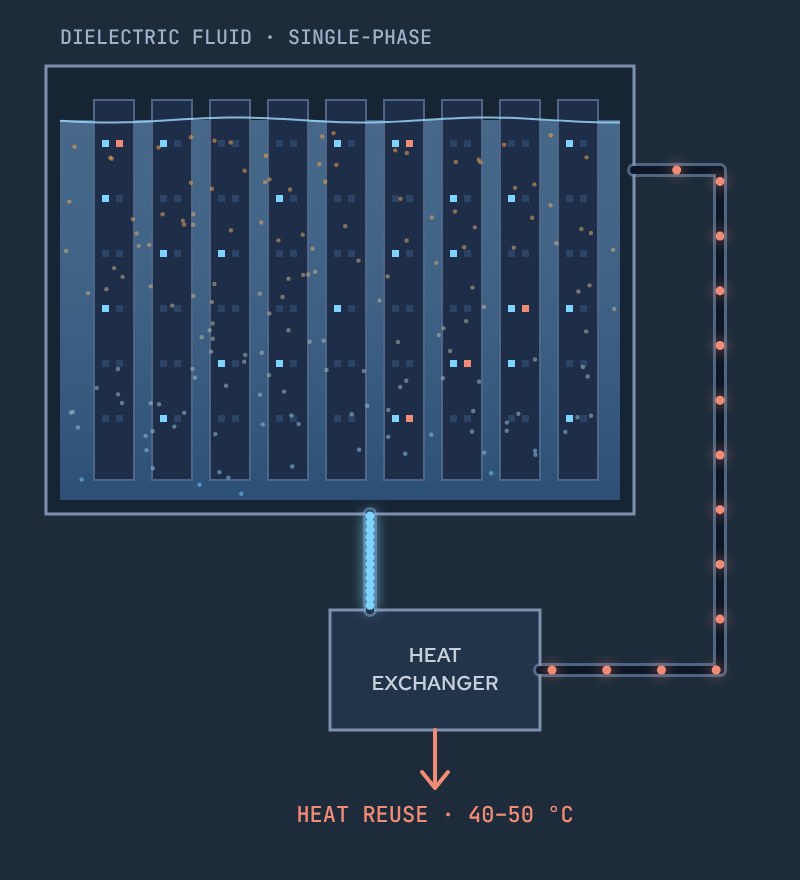
AI racks already exceed 100 kW, while air reaches about 20 kW per rack. Liquid cooling removes heat at the chip itself or by immersing servers in a dielectric fluid. It uses less energy, almost no water, and delivers heat at 40–50 °C that can be reused.
What we look at in the energy study
- Cooling sets the power: at PUE 1.1 instead of 1.5, a 10 MW IT data centre needs about 4 MW less grid capacity.
- Compliance: Spain's data-centre decree asks for the top EU water-efficiency class and a transitional PUE of 1.25.
- Heat at 40–50 °C can serve industrial processes or heat networks on the estate.
- Cooling, PV, BESS and EMS are specified as one system with the manufacturers, who keep their own equipment guarantees.
- For immersion we check server warranties, maintenance and fluid type, and favour single-phase: two-phase fluorinated fluids fall under the EU PFAS restriction.
| Technology | Density per rack | Typical PUE | Water | Where it fits |
|---|---|---|---|---|
| Air (containment or rear door) | Up to ~20 kW; ~100 kW with rear-door heat exchangers | ≈ 1.5 | High if evaporative | Existing halls and conventional IT loads |
| Direct-to-chip (cold plate) | 100–175 kW | 1.10–1.20 | Closed loop, low | Today's standard for AI racks |
| Single-phase immersion | Up to ~250 kW | 1.03–1.10 | Near zero | Highest density, water-stressed sites, heat reuse |
Typical ranges published by the industry in 2026. Each site is studied on its real load.
What is changing in Spain
Renewable power, hour by hour
- The data-centre Royal Decree in preparation requires matching consumption with renewable generation hour by hour
- Grid access for new demand is scarce: data centres hold the largest share of capacity granted, none of it yet in service
- Efficiency ceilings (PUE) make cooling and control part of the compliance case
Grid improvement
When the grid connection is the bottleneck
New data centres often wait years for capacity. Storage and control can make better use of the connection that exists and protect sensitive IT loads.
- Battery storage to manage peaks within the contracted capacity
- Power-quality correction for harmonics from UPS and IT loads
- Ride-through for voltage sags
- EMS coordination with on-site generation and the grid operator
Every size
From edge sites to campuses above 10 MW
Industrial estates with strong grid connections are becoming platforms for data centres. We assess the site, the load and the technology together, and bring the manufacturers, investors and local partners each project needs.
Do you know what your energy really costs you?
Tell us about your site, your consumption and your grid connection. The first conversation is to see whether an energy study makes sense for you.